
Sustaining anything in the region of 7% growth should be good enough in a troubled and risk-laden world, says T N Ninan.

Profits of India's top listed companies have been growing at a faster pace than those of their American peers, but when it comes to revenue growth, the order has reversed recently. The combined net profit of the S&P 500 companies was up 14.1 per cent year-on-year (Y-o-Y) during the trailing 12 months (TTM) ended December 2023, as against 17.4 per cent profit growth logged by the BSE 500 companies in the same period. This is the second consecutive year of faster profit growth for the BSE 500 companies.

India's growth in the last three financial years has averaged just 1.9%. It is natural to project rapid growth from this low base. Crucial to that would be the assumption that the economy has suffered no lasting damage from the pandemic, observes T N Ninan.

'The actions of Indian monetary authorities will depend on how quickly they want the inflation to come down to 4 per cent.'

Apart from the human body, human food will bear direct repercussions. From staples such as wheat, to coffee, dairy, and even the great Hilsa face the threat of reduced supply due to the extreme heat.

Among Sensex stocks, SBI, IndusInd Bank, HDFC Bank, Axis Bank, HDFC, Tech Mahindra, ICICI Bank, Ultratech Cement, L&T, Bajaj Finserv, Reliance, HCL Tech, Asian Paints, Wipro and M&M were the major losers. On the other hand, HUL advanced the most by 1.14 per cent. Maruti, Tata Steel, NTPC and Sun Pharma also posted gains.

'We are going to need more technical people in government.' 'You can't expect a generalist to understand the complicated world of financial engineering.' 'I regret to say that most of our politicians have no competence to deal with these things. Nor is there a willingness to learn.'

Market participants attribute the stability to the Reserve Bank of India's timely intervention in the foreign exchange market, both in terms of selling and buying dollars.

China's population in 2022 -- 1.4118 billion -- fell by 850,000 from 2021, the National Bureau of Statistics (NBS) said.

India's economic growth is likely to reach pre-COVID-19 levels by the end of the 2021-22 fiscal as the GDP contraction in this financial year is expected to be less than 8 per cent, Niti Aayog vice chairman Rajiv Kumar said on Sunday. The Reserve Bank of India (RBI) has also revised its forecast of economic growth for the current fiscal year (2020-21) to (-)7.5 per cent as against its earlier forecast of (-)9.5 per cent.

'The real lifting of the economy will happen only if this momentum sustains in the coming months.'

'Even though as Xi will seemingly continue to stay in power beyond his third term, competitions for the post-Xi leadership would be inevitably unfolded beneath the surface of water, and that will be a big headache for Xi the dictator.'

The Street will thus keep an eye on the operating profit margins over the next couple of quarters.

While foreign currency rating was retained at Baa2 -- the second-lowest investment grade score -- Moody's also projected a fiscal deficit of 3.7 per cent of gross domestic product in the year through March 2020, a breach of the government's target of 3.3 per cent.

From the Sensex basket, JSW Steel, Tata Steel, UltraTech Cement, NTPC, Larsen & Toubro and HDFC Bank were the major gainers. Titan, Nestle, Bharti Airtel and IndusInd Bank were among the laggards.

'Our vision for the future includes the creation of an active ecosystem, human space flight, a human space station.'

Riding on a bull run, equity investors became richer by Rs 128.77 lakh crore in the 2023-24 fiscal, driven by robust fundamentals of the Indian economy, increased investment inflows and promising corporate earnings. After a muted performance in 2022-23, equity markets made a remarkable recovery in FY24, giving handsome returns to investors. The 30-share BSE Sensex climbed 14,659.83 points or 24.85 per cent in 2023-24.

India remains an attractive destination for foreign direct investments (FDI) on account of healthy prospects of economic growth and its skilled workforce, according to a survey by Deloitte. A large proportion of international business leaders remain confident in India's short- and long-term prospects and are readying plans to make additional and first-time investments in the country, it said on Tuesday. "The survey, which questioned 1,200 business leaders of multinational corporations in the US, UK, Japan and Singapore, found that India remains an attractive destination for investments, scoring highly for its skilled workforce and prospects for economic growth," the survey - India's FDI Opportunity - said.

Within IIP, the capital goods sub-index has contracted for seven continuous months, suggesting investment demand continues to be weak.

Kamal Haasan is right where he left off from the first film but there is only so much he can do to salvage an already lost cause, observes Arjun Menon.

Stating that India's economic stimulus was not adequate, Banerjee said, the measures did not increase consumption spending of lower income people as the government was not willing to put money in the hands of the low income population.

The relationship between the US and India has been very productive, in particular on the trade and technology front, and 2023 can be considered the best year historically for bilateral ties, according to a former top American trade official. Arun Kumar, an Indian-American, who served as the assistant secretary of Commerce for Global Markets and director general of the US and Foreign Commercial Service (USFCS) during the Obama administration, said this during an interview with PTI in Washington. "Looking back on 2023, it was a very productive year for the US-India relationship, by many accounts the best year historically," he said.

India Inc's earnings seem to have gathered momentum with a surge in the BSE Sensex over the past two quarters.

India and Pakistan must reform their institutions of governance to accelerate economic growth on a sustained basis for poverty reduction, lawmakers and experts from both the countries attending a meeting in Dubai said notwithstanding the chill in bilateral ties.

Facing the twin task of fighting the coronavirus pandemic today and building a better tomorrow, the world is experiencing a new Bretton Woods moment, IMF managing director Kristalina Georgieva said
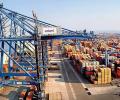
DFC is the US government's development finance institution. Adani Ports and Special Economic Zone Limited (APSEZ) in a statement said that the US fund will support the development of deepwater shipping container terminal in the Port of Colombo.

Six decades and more later, we are now captives of our identities. Every poll is based on elaborate calculations of electability of candidates on the basis of their castes and other narrow definers. That, along with voter promiscuity, is what defines our political culture, which remains stubbornly resistant to any change, asserts Shreekant Sambrani.

Jaitley's team presents a quintessential mix of foreign-educated, intellectual technocrats and seasoned bureaucrats

It further said India is facilitating external commercial borrowings by startups in order to encourage innovation and promote ease of doing business.

The government is contemplating changes to the Insolvency and Bankruptcy Code (IBC) to deal with environmental claims and liabilities of defaulting companies to make the law future-ready and meet climate action goals, sources told Business Standard. Currently, the IBC has various categories of claims and creditors, including those related to environmental liabilities.

The World Bank has appointed Indermit Gill, an Indian national, chief economist and senior vice-president for development economics at the multilateral development bank. "Indermit Gill brings to this role a combination of leadership, invaluable expertise and practical experience working with country governments on macroeconomic imbalances, growth, poverty, institutions, conflict, and climate change," World Bank President David Malpass said in a statement. His appointment will be effective September 1, 2022.

The outlook for India's rating would improve if fiscal, inflation and infrastructure metrics get better, a global report said.

The stock market, the Survey felt, had run away from underlying real economy indicators and asked if this indicated rational confidence or irrational exuberance.

With the reality of coalition politics staring the BJP in its face, this was inevitable, points out Ramesh Menon.

The government on Monday budgeted Rs 1.75 lakh crore from stake sale in public sector companies and financial institutions, including 2 PSU banks and one general insurance company, in the next fiscal year beginning April 1. The amount is lower than the record Rs 2.10 lakh crore which was budgeted to be raised from CPSE disinvestment in the current fiscal year. However, the COVID-19 pandemic impacted the government's CPSE stake sale programme, and the target has been lowered to Rs 32,000 crore in the Revised Estimates.

Among the Sensex firms, Larsen & Toubro, Tata Consultancy Services, Infosys, HCL Technologies, Hindustan Unilever, Axis Bank, ICICI Bank and Wipro were the major gainers. Nestle India, Asian Paints, JSW Steel, Kotak Mahindra Bank and HDFC Bank were among the losers.

The sustainable competitiveness report measures of the responsible growth of a state.

'Factors such as working professionals seeking better lifestyles, traditional housing challenges, community and networking, and urban migration for jobs are driving the growth in the co-living segment.'

Shares of real estate firms have been outperforming over the past year. The rally, analysts say, may hit roadblocks in the near term amid stretched valuations, even as the long-term prospects for the sector remain ebullient. "Most of the positive news flow is already in the price. Hence, investors sitting on hefty profits may partially cash out at current levels," suggests V K Vijayakumar, chief investment strategist at Geojit Financial Services.

The RBI's decision to tighten norms for unsecured personal loans is credit positive because lenders will need to allocate higher capital for such loans, thus improving their loss-absorbing buffers, Moody's Investors Service said on Monday. The Reserve Bank last week raised risk weights on unsecured retail loans, credit cards and lending to non-banking finance companies (NBFCs) by 25 percentage points. Moody's said unsecured loans have been growing rapidly in the past few years, exposing financial institutions to a potential spike in credit costs in case of sudden economic or interest rate shocks.
